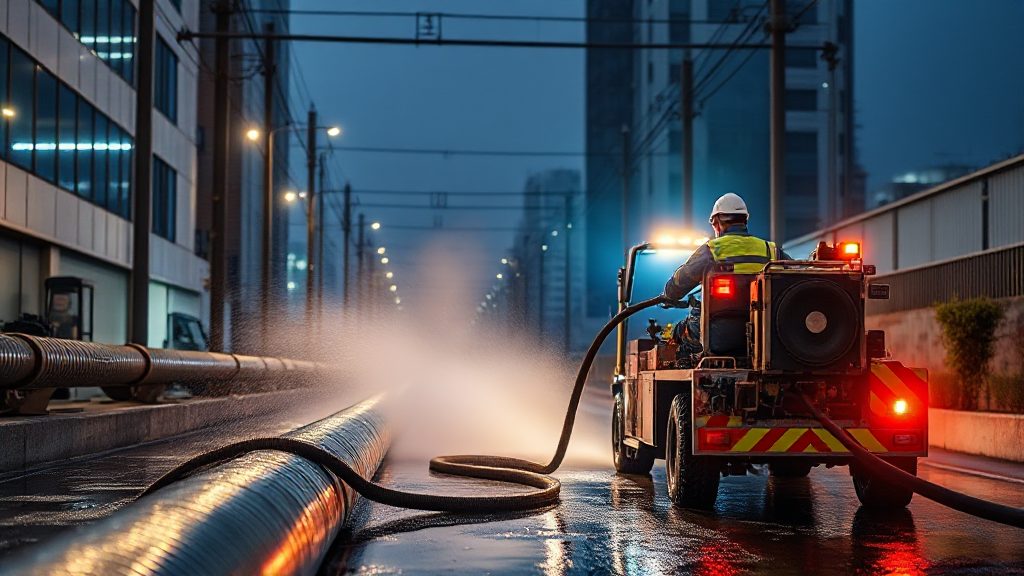
Hydrojetting on Brás Commercial Strips: When Pressure Beats a Snake
It is 11:40 p.m. on a Friday in Brás, and the dish pit has backed up again. The floor drain is rising, the pass-through sink is draining slowly, and the kitchen closes in twenty minutes. You have two options on the table: a mechanical snake that will punch a hole through the blockage, or a hydrojetting crew that will clean the pipe wall. The decision you make in that moment determines whether you are calling a desentupidora em Brás São Paulo SP again next week or not until the next quarterly maintenance.
Brás is not a residential neighborhood with occasional slow drains. It is a dense commercial corridor where restaurants, bakeries, snack bars, and food stalls share aging clay and cast-iron laterals under streets that see constant heavy traffic. Grease loading is high, pipe slopes are often compromised by decades of settlement, and a single blocked line can shut down a kitchen during the busiest service window of the week. Understanding how hydrojetting actually works, and when it genuinely outperforms a snake, is the difference between a quick fix and a lasting repair.
How Hydrojetting Clears a Grease-Loaded Line
Hydrojetting is not simply high-pressure water. It is a controlled process that uses a specialized nozzle on the end of a flexible hose to direct water at specific angles and pressures against the interior pipe wall. The nozzle typically has forward-facing jets that pull the hose into the line and clear the initial blockage, plus rear-facing jets that flush debris back toward the access point. The result is a scouring action that removes grease, soap scum, food solids, and mineral scale from the entire circumference of the pipe, not just the center.
The equipment matters as much as the technique. A professional hydrojetting truck carries a high-volume pump, a reel of reinforced hose, and a set of interchangeable nozzles sized for different pipe diameters and blockage types. A desentupidora Brás crew working on a restaurant lateral will typically start with a penetration nozzle to open a channel, then switch to a chain or rotating nozzle to cut through hardened grease and root intrusion. The final pass uses a flushing nozzle to carry the loosened material to the municipal main.
This is fundamentally different from a mechanical snake, which is a rotating cable with a cutting head. A snake opens a path through the blockage but leaves the pipe wall coated with grease and debris. That residual layer acts as a magnet for the next accumulation, which is why snaked lines in busy kitchens often re-block within weeks. Hydrojetting addresses the cause, not just the symptom.
Pressure Ranges and What They Mean for Commercial Kitchens
Pressure is the variable that separates a professional hydrojetting job from a dangerous one. Residential drain lines and older commercial laterals cannot withstand the same pressure as a modern schedule-40 PVC line. A competent technician adjusts pressure based on pipe material, diameter, age, and condition. Too little pressure and the grease stays; too much and you risk cracking cast iron, blowing joints apart, or damaging a weak section of clay tile.
In practice, most restaurant kitchen laterals in Brás fall into a pressure band where the goal is controlled scouring rather than brute force. The technician will often start at a moderate pressure to assess how the line responds, then increase incrementally while monitoring for signs of stress. A desentupidora Brás São Paulo SP team with experience in commercial corridors knows that a cautious, staged approach is faster overall than a single high-pressure blast that damages a fitting and turns a blockage into an excavation.
Three practical rules govern pressure selection in a commercial kitchen setting:
- Match the nozzle to the pipe diameter. An oversized nozzle in a small line creates back-pressure and can stall the hose; an undersized nozzle wastes water volume and fails to clean the wall.
- Reduce pressure for older or fragile materials. Cast iron with visible corrosion, clay tile with offset joints, and any line with previous repairs need a gentler pass.
- Never hydrojet a line you have not inspected. A camera survey before jetting confirms the pipe material, identifies collapses or bellies, and prevents a pressure-driven failure.
The comparison between hydrojetting and a mechanical snake is not about which tool is stronger. It is about which tool solves the problem the kitchen actually has. The table below summarizes the trade-offs in prose form for a typical Brás restaurant lateral.
| Factor | Mechanical Snake | Hydrojetting |
|---|---|---|
| Primary action | Rotating cable cuts a channel through the blockage | High-pressure water scours the full pipe wall |
| Grease removal | Partial; leaves a coating that re-accumulates | Thorough; removes grease, scale, and solids |
| Root intrusion | Can punch through roots but does not cut them cleanly | Chain nozzles cut roots at the pipe wall |
| Risk to old pipes | Lower pressure risk but cable can abrade fittings | Higher if pressure is not adjusted to pipe condition |
| Typical re-block interval in busy kitchens | Weeks to a few months | Months, especially with preventive maintenance |
| Best use case | Quick emergency opening when the line is unknown | Scheduled cleaning and stubborn grease or root blockages |
When a Snake Is the Right First Move in Brás
Despite the advantages of hydrojetting, there are situations where a mechanical snake is the correct first response. If the blockage is a solid object, such as a piece of cutlery, a broken dish, or a wad of plastic wrap, a snake can often retrieve or push it through without the water volume required for jetting. In a crowded Brás kitchen at closing time, a snake is also faster to deploy when the only goal is to get through one more service and schedule a proper cleaning later.
The key is to treat the snake as a triage tool, not a permanent solution. A snake that opens a grease line without cleaning the wall is buying time, and that time is usually measured in weeks. For restaurant owners who rely on a desentupidora em Brás São Paulo SP for emergency call-outs, the smarter play is to use the snake to restore function, then book a hydrojetting and camera inspection visit within the same week. That two-step approach keeps the kitchen running tonight and prevents the same line from failing during a holiday rush.
There is also a safety dimension. A snake operated by an inexperienced hand can kink, bind, or damage a pipe fitting, especially in older laterals with offset joints. Hydrojetting requires trained operators and proper equipment, but when performed correctly it is gentler on the pipe wall than a rotating cable because the force is distributed across the circumference rather than concentrated at a single cutting head.
Building a Maintenance Decision for Brás Restaurant Owners
For a commercial kitchen in Brás, the decision between hydrojetting and snaking should not be made in a panic at closing time. It should be built into the maintenance calendar. Restaurants that fry, grill, or prepare large volumes of food generate grease at a predictable rate. A quarterly hydrojetting pass on the main kitchen lateral, combined with monthly enzyme dosing and proper grease trap maintenance, dramatically reduces the probability of an emergency call.
The decision framework is straightforward. If the line has a history of repeated blockages within a few months, hydrojetting is the correct tool because it addresses the accumulated wall layer that a snake leaves behind. If the blockage is a one-off caused by a foreign object, a snake may be sufficient. If the pipe is old, has known bellies, or has never been inspected, a camera survey should precede any high-pressure work. And if the kitchen is in a building with shared laterals, coordination with the condominium management is essential because a blockage downstream affects every tenant on the line.
Cost is part of the decision, but not in the way most owners assume. A snake call is cheaper per visit, yet repeated snake calls over a year often exceed the cost of one scheduled hydrojetting service plus a camera inspection. The real cost of a blocked line is not the service fee; it is the lost covers, the staff overtime, the emergency premium, and the reputational damage of a closed kitchen on a Saturday night. A desentupidora Brás that offers both emergency response and preventive hydrojetting gives you the option to match the tool to the situation rather than defaulting to the cheapest immediate fix.
In the end, the choice between pressure and a snake is a choice between cleaning and clearing. Brás commercial strips demand cleaning, because the grease load is relentless and the pipes are old. A snake can open the line tonight, but hydrojetting is what keeps the kitchen open next month. Build the maintenance plan around that distinction, and the 11:40 p.m. decision becomes a scheduled task instead of an emergency.
